Works
Gabiani’s practice is one continuous investigation expressed through different visual languages. Across periods, media and forms, the work develops through an ongoing exploration of transformation, connection and perception.
Continuous Transformation
Gabiani’s practice is one continuous investigation expressed through different visual languages. Across periods, media and forms, the work develops through an ongoing exploration of transformation, connection and perception.
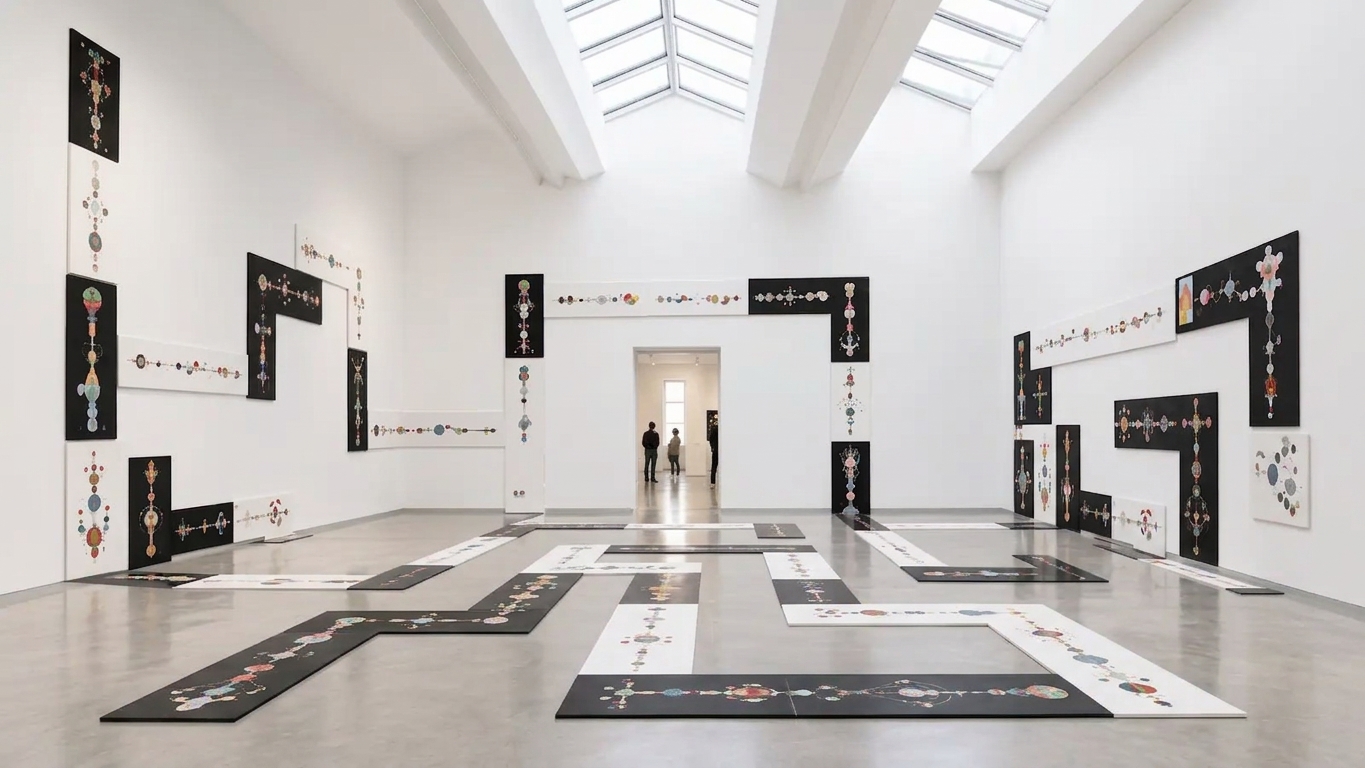
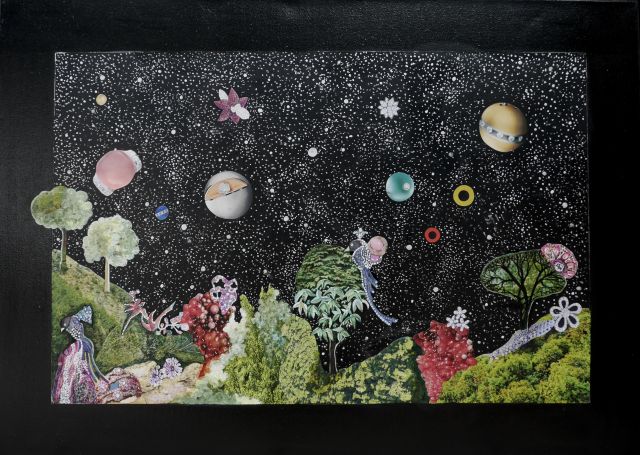
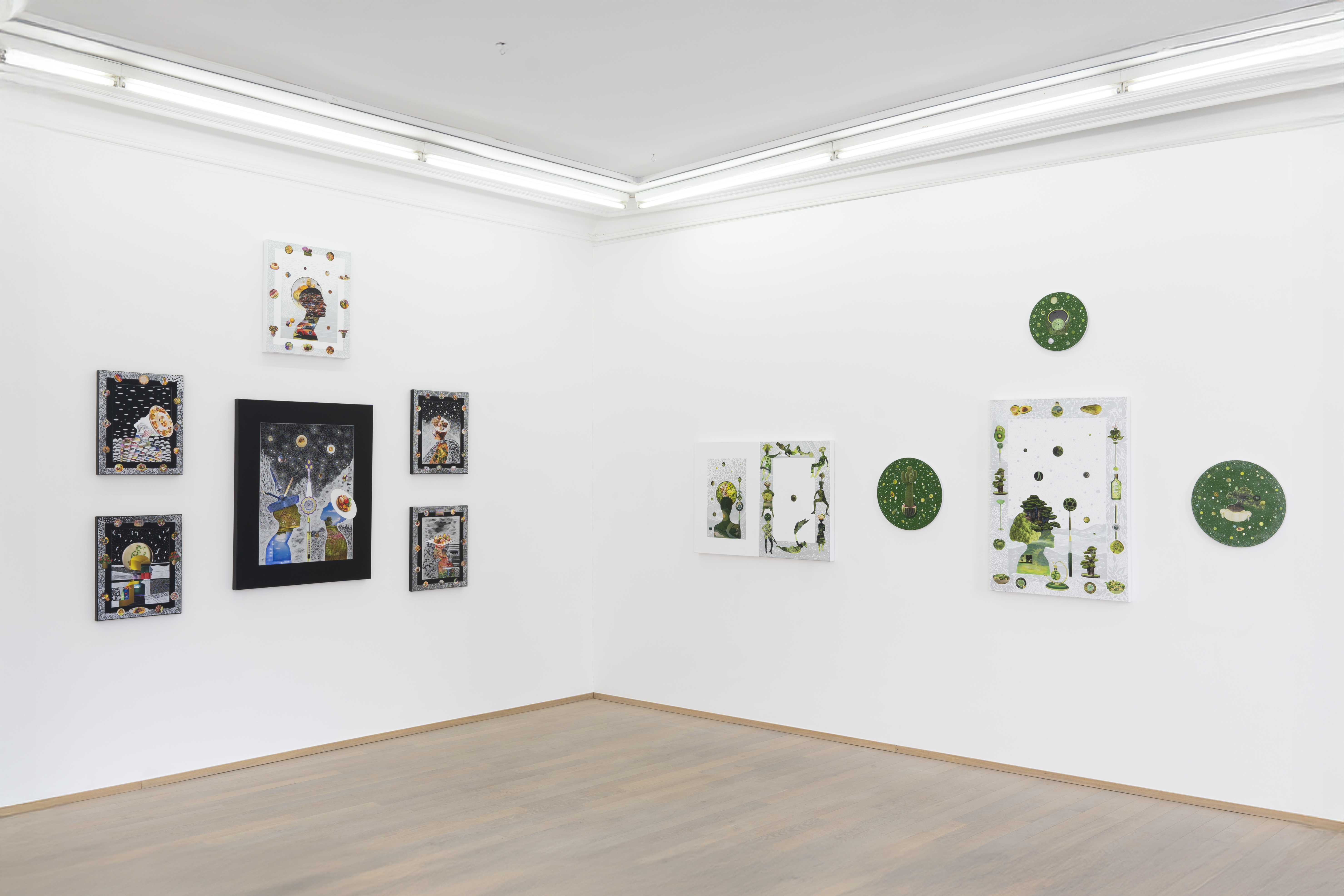
Gabiani repeatedly takes an existing form, structure, object or image and places it into a new relationship. Its scale, context, position or function changes and with it, its identity. A microscopic form can become a cosmic body; an ordinary object or fragment can be cut, reshaped or isolated until its familiar identity disappears and it begins to evoke something entirely different. A candy, a plate or a fragment of a leaf can become a planet. A landscape can move from behind a figure to within it.
Photographic fragments enter the paintings as elements of a new visual language, while a frame can cease to contain an image and become part of the image itself. Through these shifts, the same underlying principle can generate different visual structures and realities. The elements, their arrangement and their interaction shape how the principle becomes visible, changing the composition and its perception without necessarily altering the principle itself.
This process also operates within the development of patterns. By repeating a pattern found within an image and allowing it to extend into another, Gabiani creates connections that develop according to an established rule. As the pattern encounters new images and structures, it transforms in response to them. Although the rule provides continuity, the resulting visual form is not predetermined. Gabiani decides how the pattern develops, where it continues and when it changes, allowing the process itself to contribute to the formation of the work.
The same principle operates in the way Gabiani develops her own visual rules. She creates a structure, explores its possibilities, pushes it to its limits and then transforms it. What may appear to be a departure from one body of work is often a continuation of the same investigation through another form.
Her practice therefore does not develop as a linear succession of separate styles. Ideas may disappear from view, return years later, intersect with other ideas and emerge in a different form. Earlier discoveries remain active within the larger network of the work, even when their original visual language has disappeared.
Visually, the practice is constantly changing. Conceptually, its underlying logic remains remarkably continuous.
What appears to be many different directions is, in fact, one interconnected investigation: one concept translated through different visual languages.
This continuity is also a process of return. Nothing is abandoned; it returns transformed. In this sense, the practice follows the logic of the Universe itself: nothing remains fixed, and transformation continuously generates new forms.